
These are stretches I'm going to try to do everyday. With my injured shoulder, some might have to wait or be modified, but I'll at least have a reference when I need it.
1. Neck, Scalene and Upper Trapezius
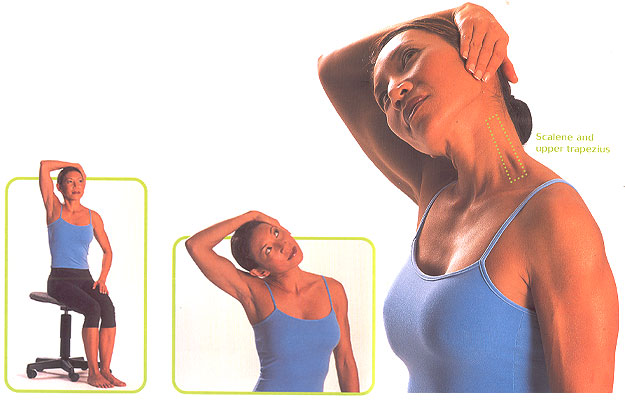
Place a hand on the side of your head and breathe in. The hand is used only as a guide and does not drive the motion.
Activate the opposing scalene muscles by flexing the neck to the side until you reach your barrier. Once your barrier has been reached, gently pull and hold for two seconds while breathing out, then return to neutral (the starting position). Repeat 10 times.
2. Pectoralis Minor (chest)
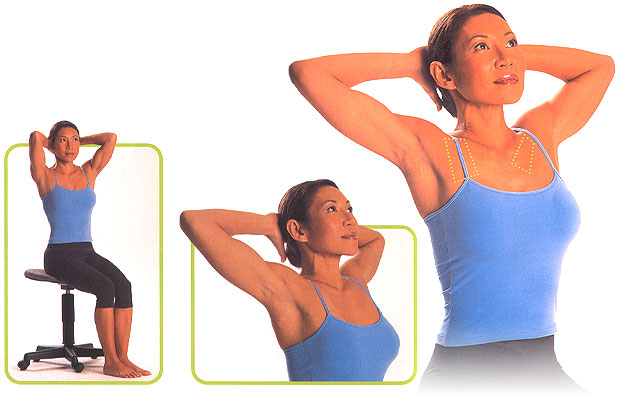
Pull your shoulder back and breathe out, extending the elbows and contracting the muscles in the back (rhomboids, middle trapezius). When you reach the end point, lift your shoulders at a 45-degree angle to target the pictoralis minor. Hold for two seconds and release back to neutral. Repeat 10 times.
3. Posterior Deltoid and shoulder capsule
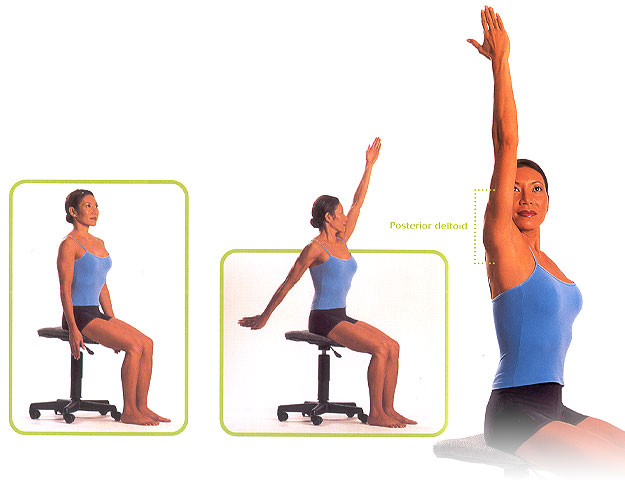
Sitting down, take a deep breath. Don’t lean forward. Keep your back straight and tighten your stomach.
Breathe out, raise one arm above your head to maximum range, pointing your fingers upwards, and bring the other arm backwards to the maximum point as a counterbalance. The anterior deltoid is the prime mover here. Hold for two seconds. Repeat 10 times on each side.
4. Erector Spinae (back extensors)
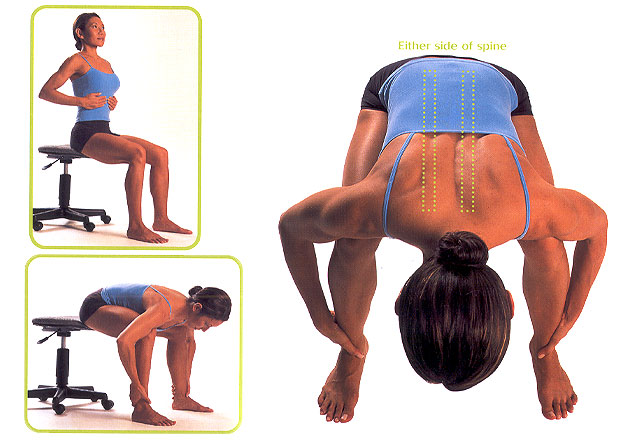
Sitting up, hold the upper abs (rectus abdominus). Breathe in and lengthen through your spine. Relax your neck and shoulders.
Contract your abdominals, which releases and relaxes the erector spinae muscle group. Lean forward with a straight back and grab hold of your ankles. Pull through to your barrier, hold for two seconds, then release back to neutral. Repeat 10 times.
5. Upper Quadriceps (thigh)
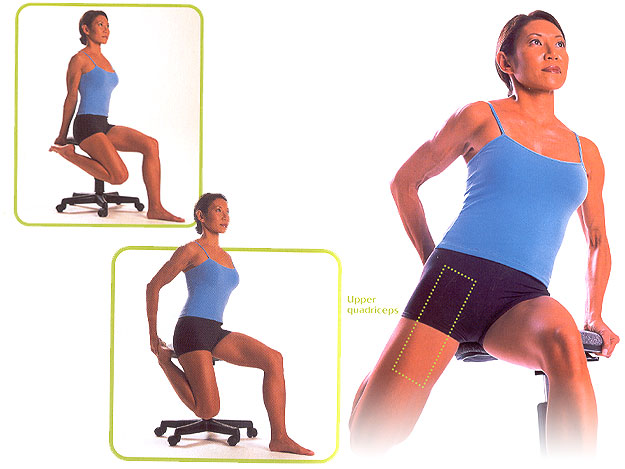
Sitting in a neutral position, breathe in and lift your heel into your bottom. Keep your back straight and your stomach tight.
Extend the hips using the hamstring and the gluteals (buttock muscles), which are driving the movement; the hand is merely a guide. When you reach your barrier, use your hand to pull through the barrier to the point of light irritation. Hold for two seconds and release back to start. Repeat 10 times.
The upper quad is generally the tightest part of the thigh. You should feel the stretch at the Alls (anterior inferior iliac spine) attachment of the rectus femoris.
6. Seated Bent Leg Hamstring
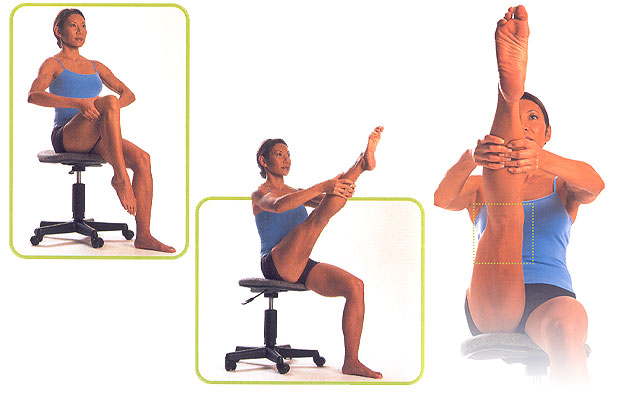
The quadriceps extends the knee and drives the motion. The hands are guides; move them below the knee to the calf. Lock your knee, but don’t hyperextend. When you get to the end of the movement, use your hands to push slightly forward to the point of light irritation. Hold two seconds and release. Repeat 10 times.
7. Psoas Major and Minor (hip flexor)
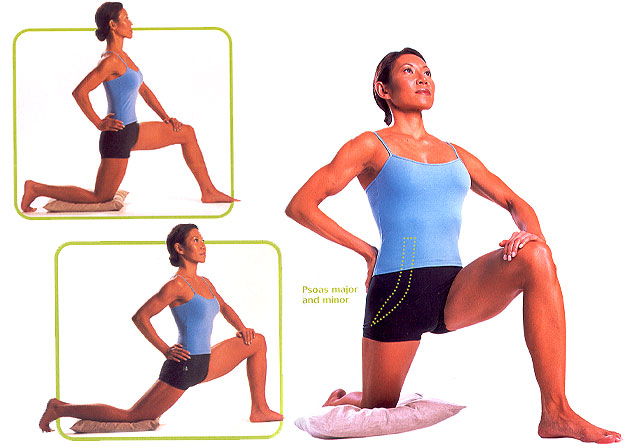
The driving force of this stretch is the opposing muscle in the gluteus maximus. Tighten your buttocks to extend your hip and push forward from your hips. Keep your hand passive until your reach your barrier, then use it to push through to a point of light irritation. Hold for two seconds and return to neutral. Repeat 10 times. It’s important to not allow the knee to go over the front of the foot to avoid straining the patella ligament (where the quads are attached just below the kneecap.
8. Spine Rotator
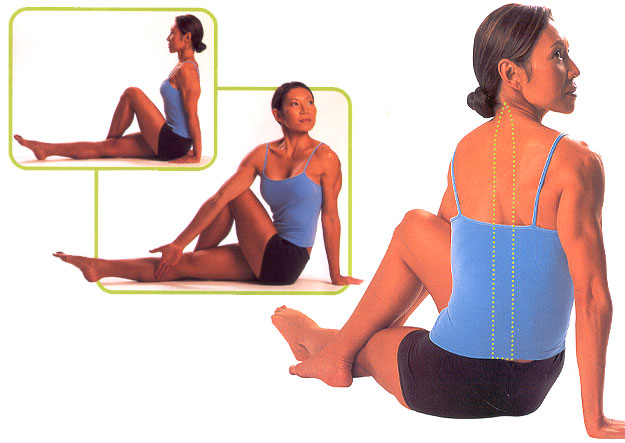
Breathing out, rotate your spine to your maximum position, putting your arm against your knee for leverage. The back hand is a second lever. Rotate your head and try to look over your shoulder. Hold for two seconds and return to the starting position. Repeat 10 times.
9. Internal obliques (sides of upper body)
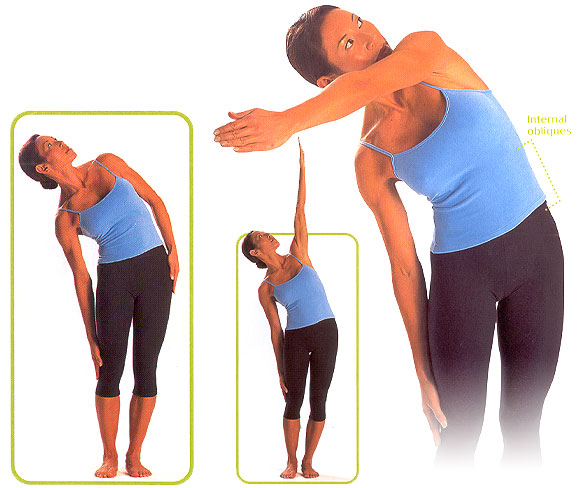
Breathe out and extend the opposite arm upwards. Look up at your pointed fingers for deeper movement.
This is a slightly advanced movement for those with sufficient flexibility. Lean across at 45 degrees to finish off the motion. The internal obliques range from the top of the hip to the 12th rib.
10. Outside Lateral Gluteus Maximus (buttock)

The muscles driving this action are the quads and hip flexors. Put one hand on your knee and one on your ankle. Move your knee to the opposite shoulder. Breathe out, hold for two seconds, release back to start. Repeat 10 times.
This very informative material has been copied from a book "Stretch Your Life", published in 2004 and co-written by Stretch Asia partner, Chris Watts. The source of your material is therefore not correct and I would appreciate that you link it to the correct provider www.stretchasia.com. Thank you.
ReplyDelete