source: http://womenfitness.net/top10_everyday_stretches.htm
These are stretches I'm going to try to do everyday. With my injured shoulder, some might have to wait or be modified, but I'll at least have a reference when I need it.
1. Neck, Scalene and Upper Trapezius
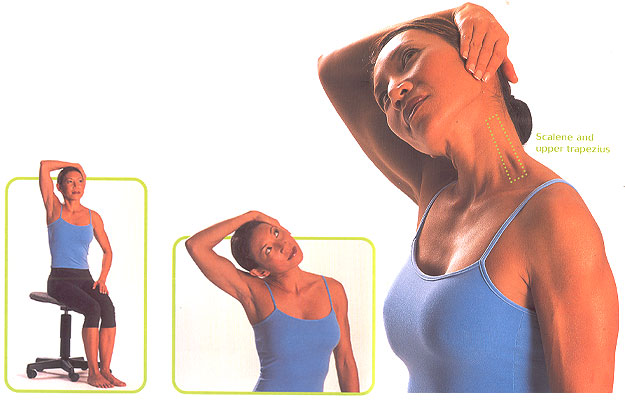
Place a hand on the side of your head and breathe in. The hand is used only as a guide and does not drive the motion.
Activate the opposing scalene muscles by flexing the neck to the side until you reach your barrier. Once your barrier has been reached, gently pull and hold for two seconds while breathing out, then return to neutral (the starting position). Repeat 10 times.
2. Pectoralis Minor (chest)
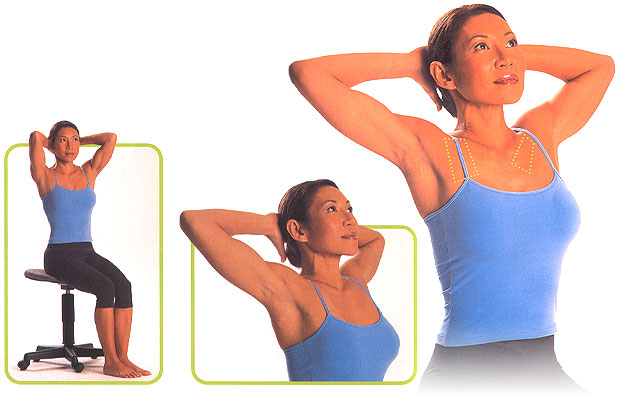
Breathe in and place your hands in a position like you’re under arrest.
Pull your shoulder back and breathe out, extending the elbows and contracting the muscles in the back (rhomboids, middle trapezius). When you reach the end point, lift your shoulders at a 45-degree angle to target the pictoralis minor. Hold for two seconds and release back to neutral. Repeat 10 times.
3. Posterior Deltoid and shoulder capsule
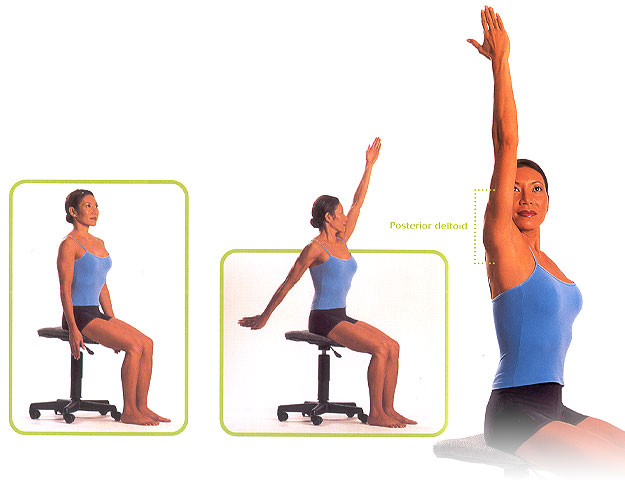
Sitting down, take a deep breath. Don’t lean forward. Keep your back straight and tighten your stomach.
Breathe out, raise one arm above your head to maximum range, pointing your fingers upwards, and bring the other arm backwards to the maximum point as a counterbalance. The anterior deltoid is the prime mover here. Hold for two seconds. Repeat 10 times on each side.
4. Erector Spinae (back extensors)
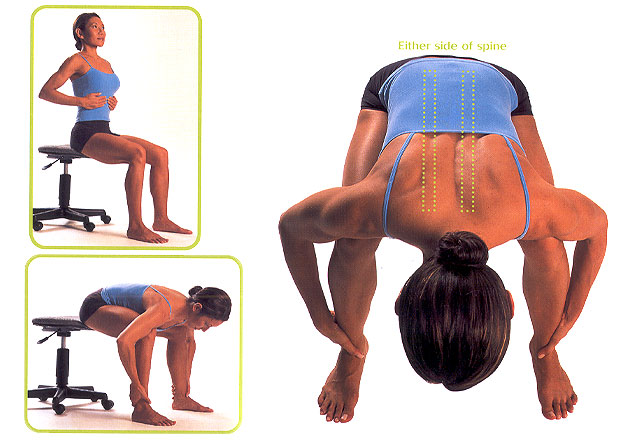
Sitting up, hold the upper abs (rectus abdominus). Breathe in and lengthen through your spine. Relax your neck and shoulders.
Contract your abdominals, which releases and relaxes the erector spinae muscle group. Lean forward with a straight back and grab hold of your ankles. Pull through to your barrier, hold for two seconds, then release back to neutral. Repeat 10 times.
5. Upper Quadriceps (thigh)
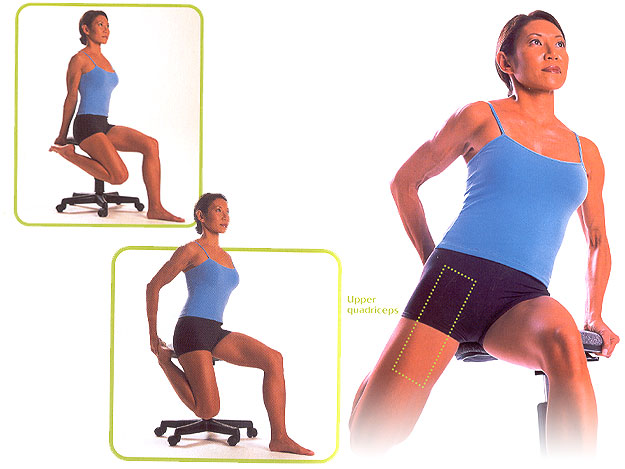
Sitting in a neutral position, breathe in and lift your heel into your bottom. Keep your back straight and your stomach tight.
Extend the hips using the hamstring and the gluteals (buttock muscles), which are driving the movement; the hand is merely a guide. When you reach your barrier, use your hand to pull through the barrier to the point of light irritation. Hold for two seconds and release back to start. Repeat 10 times.
The upper quad is generally the tightest part of the thigh. You should feel the stretch at the Alls (anterior inferior iliac spine) attachment of the rectus femoris.
6. Seated Bent Leg Hamstring
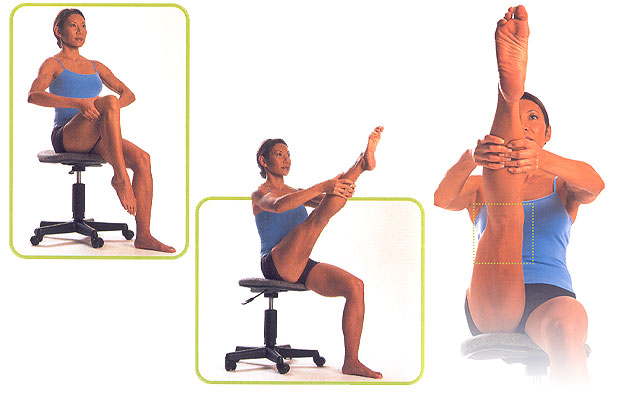
Sitting down, hold your hamstring just above the knee. Breathe in and contract your stomach.
The quadriceps extends the knee and drives the motion. The hands are guides; move them below the knee to the calf. Lock your knee, but don’t hyperextend. When you get to the end of the movement, use your hands to push slightly forward to the point of light irritation. Hold two seconds and release. Repeat 10 times.
7. Psoas Major and Minor (hip flexor)
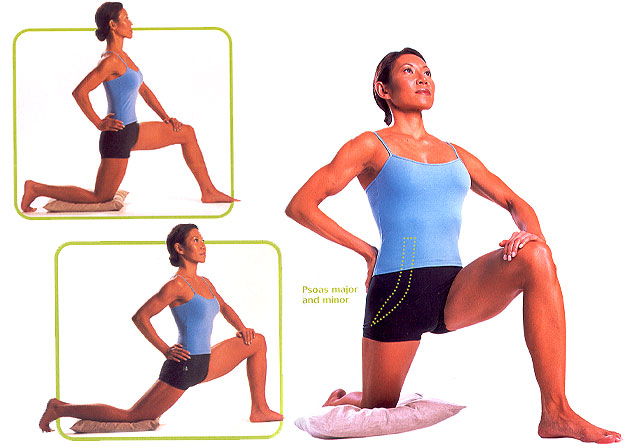
Rest one knee on a cushion. Your back should be straight and your stomach tight, with your pelvis in a neutral position. Place one hand on your hip and the other on your knee. With shoulders and arms relaxed, take a deep breath.
The driving force of this stretch is the opposing muscle in the gluteus maximus. Tighten your buttocks to extend your hip and push forward from your hips. Keep your hand passive until your reach your barrier, then use it to push through to a point of light irritation. Hold for two seconds and return to neutral. Repeat 10 times. It’s important to not allow the knee to go over the front of the foot to avoid straining the patella ligament (where the quads are attached just below the kneecap.
8. Spine Rotator
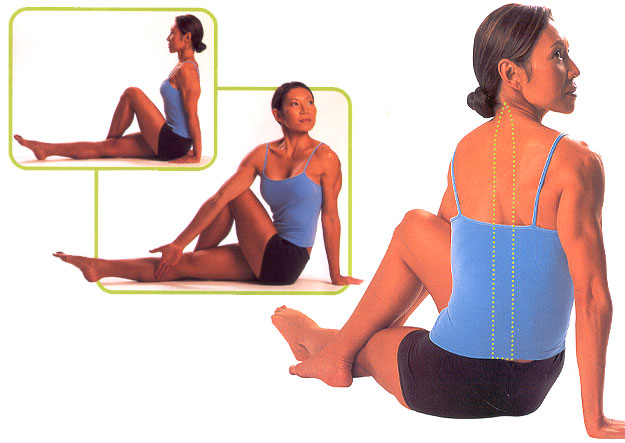
Sitting down, keep your back straight. Cross one leg over the other. Relax your spine, using your palms as balance to help keep it straight. Breathe in deeply. The objective is to achieve elongation and rotation of the spine.
Breathing out, rotate your spine to your maximum position, putting your arm against your knee for leverage. The back hand is a second lever. Rotate your head and try to look over your shoulder. Hold for two seconds and return to the starting position. Repeat 10 times.
9. Internal obliques (sides of upper body)
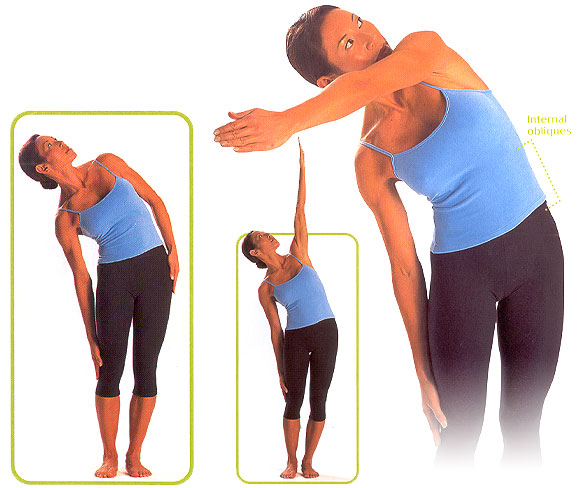
Standing, breathe in and side-bend as far as you can.
Breathe out and extend the opposite arm upwards. Look up at your pointed fingers for deeper movement.
This is a slightly advanced movement for those with sufficient flexibility. Lean across at 45 degrees to finish off the motion. The internal obliques range from the top of the hip to the 12th rib.
10. Outside Lateral Gluteus Maximus (buttock)
Lying on your back raise your knee to 90 degrees and externally rotate your thigh by turning your foot in. Breathe in.
The muscles driving this action are the quads and hip flexors. Put one hand on your knee and one on your ankle. Move your knee to the opposite shoulder. Breathe out, hold for two seconds, release back to start. Repeat 10 times.
Getting Fit like a Tank?
One girl's quest to turn working out into a game
Thursday, August 16, 2012
Macronutrient Needs
Labels:
diet
source: http://forum.bodybuilding.com/showthread.php?t=121703921
Protein
The general sports nutrition guideline based on most studies out suggest that in the face of adequate calories and carbs then the following protein intakes are sufficient:
STRENGTH training -> 1.2 to 1.6g per KG bodyweight (about .6 / pound)
ENDURANCE training -> 1.4 to 1.8g per KG bodyweight (about .8 / pound)
ADOLESCENT in training -> 1.8 to 2.2g per KG bodyweight (about 1g / pound)
Eventually I want to get into a well rounded training of cardio and strength exercises, so I'm going to go with 1.5g per kg bodyweight.
1.5g x 68kg = 102g of protein per day
Fats
Generally speaking, although the body can get away with short periods of very low fat, in the long run your body NEEDS fat to maintain general health, satiety, and sanity. General guides:
Average or lean: 1 - 2g fat/ kg body weight [between 0.45 - 1g total weight/ pounds]
High bodyfat: 1-2g fat/ LEAN weight [between 0.45 - 1g LEAN weight/ pounds]
IF low calorie dieting - you can decrease further, but as a minimum, it is not suggested to have LESS than about 0.35g/ pound.
I'm pretty average for bodyfat, but I don't want to live like I'm dieting non-stop or I'll go mad. 2g per kg for me!
2g x 68kg = 136g of fat per day
Carbs
Since I'm not an athlete, I will calculate my carbs from the calories left over from fats/ protein:
carb calories = Total calorie needs - ([protein grams as above x 4] + [fat grams as above x 9])
carbs in grams = above total/ 4
So for me, the formula is:
2100 - [(102 x 4) + (136 x 9)] = 468
468/4 = 117g of carbs per day
To summarize, my daily macronutrient intake should be:
102g of protein per day
136g of fat per day
117g of carbs per day
Protein
The general sports nutrition guideline based on most studies out suggest that in the face of adequate calories and carbs then the following protein intakes are sufficient:
STRENGTH training -> 1.2 to 1.6g per KG bodyweight (about .6 / pound)
ENDURANCE training -> 1.4 to 1.8g per KG bodyweight (about .8 / pound)
ADOLESCENT in training -> 1.8 to 2.2g per KG bodyweight (about 1g / pound)
Eventually I want to get into a well rounded training of cardio and strength exercises, so I'm going to go with 1.5g per kg bodyweight.
1.5g x 68kg = 102g of protein per day
Fats
Generally speaking, although the body can get away with short periods of very low fat, in the long run your body NEEDS fat to maintain general health, satiety, and sanity. General guides:
Average or lean: 1 - 2g fat/ kg body weight [between 0.45 - 1g total weight/ pounds]
High bodyfat: 1-2g fat/ LEAN weight [between 0.45 - 1g LEAN weight/ pounds]
IF low calorie dieting - you can decrease further, but as a minimum, it is not suggested to have LESS than about 0.35g/ pound.
I'm pretty average for bodyfat, but I don't want to live like I'm dieting non-stop or I'll go mad. 2g per kg for me!
2g x 68kg = 136g of fat per day
Carbs
Since I'm not an athlete, I will calculate my carbs from the calories left over from fats/ protein:
carb calories = Total calorie needs - ([protein grams as above x 4] + [fat grams as above x 9])
carbs in grams = above total/ 4
So for me, the formula is:
2100 - [(102 x 4) + (136 x 9)] = 468
468/4 = 117g of carbs per day
To summarize, my daily macronutrient intake should be:
102g of protein per day
136g of fat per day
117g of carbs per day
How many calories do I need?
Labels:
diet
I'll need to calculate my TEE first:
BMR (Basal Metabolic Rate) - Mifflin-St Jeor formula
Men: BMR = [9.99 x weight (kg)] + [6.25 x height (cm)] - [4.92 x age (years)] + 5
Women: BMR = [9.99 x weight (kg)] + [6.25 x height (cm)] - [4.92 x age (years)] - 161
so my BMR would be:
BMR = [9.99 x 68kg] + [6.25 x 172cm] - [4.92 x 22yrs] - 161 = 1485.08
TEE (Total Energy Expenditure)
BMR x activity variable
Activity variables
1.2 = Sedentary (Little or no exercise + desk job)
What are my goals?
At first I want to lose weight before I start toning. No, I'm not overweight, nor do I wish to look as skinny as I did in high school (shudder), but I want to be able to see the progress I'm making so I'm doing to try to shed the fat first. If I'm wrong PLEASE tell me in the comments, I'm not an expert and am just trying to figure all this out!
To ADD weight: ADD 10-20% calories to the total above
I don't want to lose a lot of weight, nor do I want to lose it quickly. So my ideal daily caloric intake will be:
So that's
BMR x activity variable
Activity variables
1.2 = Sedentary (Little or no exercise + desk job)
1.3-1.4 = Lightly Active (Little daily activity & light exercise 1-3 days a week)
1.5-1.6 = Moderately Active (Moderately active daily life & Moderate exercise 3-5 days a week)
1.7-1.8 = Very Active (Physically demanding lifestyle & Hard exercise or sports 6-7 days a week)
1.9-2.0 = Extremely Active (Hard daily exercise or sports and physical job)
Taking my activity variable to be 1.6 (I game hard, so I'm picking moderately active to suit that), my TEE would be:
1485.08 x 1.6 = 2376.128
At first I want to lose weight before I start toning. No, I'm not overweight, nor do I wish to look as skinny as I did in high school (shudder), but I want to be able to see the progress I'm making so I'm doing to try to shed the fat first. If I'm wrong PLEASE tell me in the comments, I'm not an expert and am just trying to figure all this out!
To ADD weight: ADD 10-20% calories to the total above
To LOSE weight: SUBTRACT 10-20% calories from the total above
2376.128 x (100-10)/100 = 2138.5152
2100 calories/day
Ten Ways to Build a Better Body
Labels:
fitness
source: http://www.womenshealthandfitness.com.au/fitness/workouts/410-10-ways-to-build-a-better-body
1. Reconnect with your body
yoga or stretching, in my case working around my injury to feel how my body moves
2. Work your muscles at home
squats, tricep dips, lunges, push ups, wall-sits, calf-raises, planks, abdominal crunches, etc. 3 sets of each at 10 - 20 reps once or twice a week
3. Don't forget cardio
brisk walks, jogging, swimming, cycling, rollerblading, etc. 30-60 minutes of aerobic exercise three to five times a week with stretching before and after
4. You are what you eat
figure out a diet that works http://forum.bodybuilding.com/showthread.php?t=121703921
5. Wear clothes for your body type
don't wait until you're the perfect size to wear clothes that make you feel great
6. Look at your body as a whole
experience and view your body as a whole, not individual parts that need improvement
7. Be positive
look the best you can and be confident each day - smile!
8. Indulge in body pleasures
treat yourself for working so hard! ie massages or long, hot baths (not in a student house! ew!)
9. Your body is unique and so are you
recognize that your body is unique to you, and you're already lucky to look as good as you do right now!
10. Track your progress
- weight
weigh yourself before you begin and track progress weekly, weigh at the same time of day on the same set of scales if possible
figure out a diet that works http://forum.bodybuilding.com/showthread.php?t=121703921
5. Wear clothes for your body type
don't wait until you're the perfect size to wear clothes that make you feel great
6. Look at your body as a whole
experience and view your body as a whole, not individual parts that need improvement
7. Be positive
look the best you can and be confident each day - smile!
8. Indulge in body pleasures
treat yourself for working so hard! ie massages or long, hot baths (not in a student house! ew!)
9. Your body is unique and so are you
recognize that your body is unique to you, and you're already lucky to look as good as you do right now!
10. Track your progress
- weight
weigh yourself before you begin and track progress weekly, weigh at the same time of day on the same set of scales if possible
- skin folds
measure key areas such as bicep, tricep, stomach and back. yeah... no idea how to do this. my stomach is a bit chunky, but not nearly enough to measure this. maybe take literal measurements now and again in two months? needs professional help >.<
- clothes
note size and fit now and again after two months
- flexibility, strength, and cardio
1. see if you can touch your toes
2. try 10 push-ups, sit-ups, tricep dips, and lunges
3. go for a jog and see how long you can last before you have to walk
assess now and again in 2-3 months
1. see if you can touch your toes
2. try 10 push-ups, sit-ups, tricep dips, and lunges
3. go for a jog and see how long you can last before you have to walk
assess now and again in 2-3 months
- energy levels
how's your digestive system treating you? do you have enough energy to do what you want? do you generally feel happy, healthy, and fit?
The pre-beginning
Labels:
methodology
After watching a number of TED videos about gaming, I decided to use some of the best parts about gaming and the things that allow me to spend 4+ hours a day on WoW and SW:TOR, and apply them to areas I need more motivation in. One of those being fitness. I often complain about my body shape to my boyfriend, and his answer is "then do something about it." Not because he thinks I should change, but because he knows I can if I set my mind to it.
So my goal is to learn about fitness, learn what I need to do to accomplish my goals, and come up with a gaming style levelling system. I have no idea what that means yet, but I'm just tracking my thoughts, research, and progress. Mostly for my own memory. I'm hoping to have some kind of plan ready to start by the time school starts.
Today, I'm learning about fitness goals.
Subscribe to:
Posts (Atom)


